
Exploring Honest Questions About Faith
In chapter 6 of the book of John, we meet many people who are struggling to make sense of Jesus’ words, “I am the bread of life” (John 6:35). The setting is not a quiet retreat but a packed synagogue in Capernaum.
Thousands have followed Jesus after the feeding of the 5,000. They’ve seen the miracle of the loaves and fish multiplied, heard about the storm stilled, and now gather to hear Jesus, bringing their curiosity and questions with them.
We may recognize something of ourselves in that crowd. Maybe you’re just getting to know Jesus, working through hurt from a previous church, or hoping to find a community where you can belong.
John 6 makes room for honest questions without pretending the answers are easy, and it doesn’t hide the painful reality that some people walk away.
The Seven Questions in a Crowded Synagogue
As John tells the story, questions guide the conversation. We can follow seven moments of questioning before Peter’s final response. What begins with curiosity grows into grumbling, disagreement, and, for some, a decision to walk away.
If you’ve ever found yourself moving between interest, frustration, and doubt as you explore faith, parts of this conversation may feel familiar.

Listen to a few of them: “Rabbi, when did you get here?” (John 6:25). That is a question about origins and stability: “How long have you been doing this? Is this tradition solid?”
Then they ask, “What must we do, to be doing the works of God?” (6:28). That is the belonging question: “What does God actually require of me if I stay here?”
Others ask about benefits: “What sign will you give…?” (6:30) and “Sir, always give us this bread” (6:34). Today, we might translate that as, “Will I find what I truly need here? Can I trust you to keep caring for me?”
As the conversation continues, the questions become harder: “Is this not Jesus, the son of Joseph?” (John 6:42), “How can this man give us his flesh to eat?” (John 6:52), and finally, “Who can accept this teaching?” (John 6:60).
If you’ve ever sat in church wondering how to make sense of Jesus’ words, you’re not alone. John 6 brings those struggles into the open and gives us room to acknowledge our own.
Why Some Walk Away When Jesus Feels Too Demanding
Then comes a painful moment: “Because of this many of his disciples turned back and no longer went about with him” (John 6:66). These were people who had been following Jesus, not simply watching from a distance.
Now they find his teaching too difficult to accept and choose to leave.
It’s a reminder that the struggle to keep following Jesus isn’t new, even among those who have already walked with him.
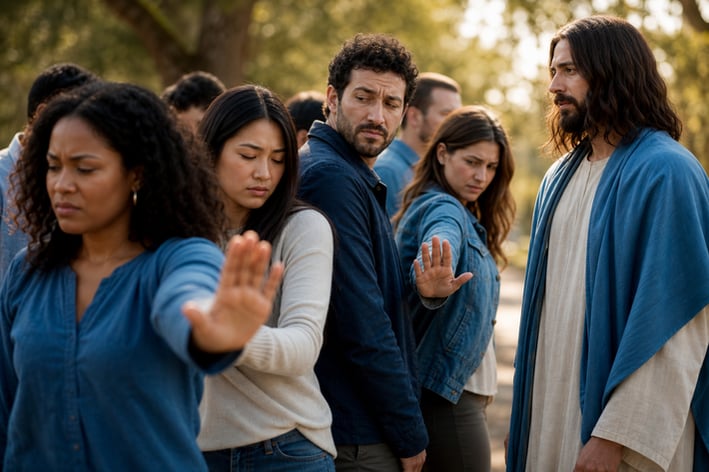
We live in a similar moment. Recent research from Lifeway Research found that 25% of U.S. Protestant churchgoers now say that, in difficult circumstances, they sometimes doubt that God loves them and will provide for them, up from 15% in 2012 and 18% in 2019.
And a study summarized by the Barna Group reports that 42% of adults, including 37% of Christians, say they have “deconstructed the faith of their youth.”
Behind those statistics are stories very much like the ones in Capernaum: people burned by a tradition, disappointed when a real need went unmet, or scandalized by what Jesus actually claims about himself.
John does not hide the fact that some leave. Instead, he asks you to be honest about which question in the synagogue feels most like your own, and whether walking away would really give you the life you seek.
Jesus as the Bread of Life
In the middle of all these questions, Jesus offers these remarkable words: “I am the bread of life” (John 6:35). He isn’t simply offering another meal; he’s offering himself.

Scholar Sumitha D’Souza has argued that John 6 brings us to the heart of the Gospel’s message. The chapter takes us from the story of manna feeding God’s people in the wilderness to Jesus, the true bread from heaven who gives us life.
Notice how Jesus responds when the people ask what God requires of them: “The work of God is this, that you believe in him whom he has sent” (John 6:29). He returns to this invitation to believe in John 6:40 and 6:47.
At the heart of faith is not a checklist of spiritual tasks, but a relationship with Jesus himself. He promises to give his flesh “for the life of the world” (John 6:51).
His words point us toward his self-giving love on the cross and invite us to recognize that same gift in the Holy Communion, where we receive him and are nourished by his life.
That is where Jesus’ words can feel especially challenging.
It may seem easier to welcome him as a wise teacher offering helpful advice than as the one who gives his very life for us. But John points us to something deeper: Jesus brings life to the world through his self-giving love on the cross.
If that sounds extreme, John would say you are finally hearing the claim clearly.
From Doubt to ‘Lord, To Whom Shall We Go?’
When many walk away, Jesus turns to the twelve and asks, “Do you also wish to go away?” (John 6:67). He doesn’t make his teaching easier to win them back. He looks his closest friends in the eye and gives them full freedom to leave.
It is one of the most vulnerable moments in the Gospels.
Peter answers with a simple, heartfelt expression of trust: “Lord, to whom shall we go? You have the words of eternal life. We have come to believe and to know that you are the Holy One of God” (John 6:68–69).
Notice those words: “we have come to believe and to know.” They suggest a faith that has grown through time spent with Jesus. Peter doesn’t claim to understand everything.
We might hear his response this way: “Jesus, I still have questions, but I’ve come to trust you. You’re the one I want to stay with.”

With so many Christians reexamining the faith they grew up with, Peter’s words offer a reminder: trusting Jesus doesn’t mean pretending we have no doubts. It can mean bringing our questions to him and continuing the journey together.
You don’t have to work everything out today. For now, you can take one small step toward trusting Jesus with your questions and your life.
Explore John 6 Further in the Full Sermon
If you are carrying quiet doubts, or if someone you love is on the edge of walking away, consider setting aside time this week to watch the sermon with an open Bible in John 6. Let yourself hear the questions, feel the tension in the room, and watch how Jesus refuses both to water down his claim and to push doubters away.
One video won’t answer every question, and that’s okay. Our hope is that it helps you see Jesus afresh: crucified, risen, and offering himself as the bread of life. Like Peter, you may find a reason to keep turning to the one who has the words of eternal life (John 6:68).
Like this Article? Share it!


Support the Mission
If you found this article helpful, please consider supporting the mission so we can continue writing these articles to help others who are looking for answers. Thank you!