
When Religion Becomes a Barrier Instead of a Bridge to God
When religion gets in the way of faith, it usually happens quietly: church becomes routine, pain from past hypocrisy lingers, and the noise of spiritual activity drowns out a living relationship with Jesus himself. Many people don’t leave faith overnight; they slowly drift when religion feels busy but empty.
You can see this all around us. Recent studies suggest that around 40 million Americans have stopped attending church in the last few decades, a shift some researchers now call “the Great Dechurching” (ChurchLeaders).
Another study found that 64% of young adults who grew up in church withdrew from regular involvement as adults (Answered Faith).
Many of them will tell you they didn’t stop believing overnight; they just stopped seeing how church connected to real life.
For some, the hurt is deep and personal: abuse, manipulation, or betrayal from people who claimed to speak for God. For others, it shows up more quietly, but it can still do real damage: services that begin to feel like background noise, rituals that no longer seem to lead anywhere, and a sense that religion is just running in the background of life without truly changing the heart.
Sometimes religion itself can get in the way of faith.
If that describes you—tired, skeptical, or just numb—you are not alone, and you are not invisible to Jesus. In John 2, he walks straight into a religious setting full of activity and decides it must be disrupted for people to meet God again.
What Jesus Was Really Doing When He Cleansed the Temple
Jesus cleansed the temple not because he hated the temple but because he refused to let necessary religious practices become the main thing, crowding out living worship of God and obscuring his own identity as the true temple.
He steps in when good things slowly drift into becoming ultimate things.
At Passover, the temple courts were crowded. Pilgrims had come from all over the ancient world, and many of them needed animals for sacrifice and money exchanged into temple currency.
There was nothing wrong with those needs in themselves; much of it was meant to help people worship.

But when Jesus entered the outer courts, the space was no longer marked by prayer, confession, or praise. Instead, it was filled with buying and selling, tables everywhere, the clinking of coins, and the sounds of animals.
John carefully traces four actions. Jesus went up to Jerusalem (v.13). He found people selling and exchanging (v.14). He made a whip out of cords (v.15). And then he said, “Get these out of here! Stop turning my Father’s house into a market!” (v.16).
This is not Jesus losing control in a burst of anger. It is a deliberate act of holy zeal. He sees what is happening. He knows what must be done. And he acts.
Notice, too, what Jesus is driving out. He is not clearing the temple of idols or pagan altars the way some Old Testament reforming kings did. He is driving out religious supports that were meant to help but had slowly taken over the center.
Good and useful things, sacrificial animals and money-changing tables, had become the main focus, especially for the people who could only come as far as the outer courts.
John places this temple cleansing near the beginning of Jesus’ ministry, unlike the other Gospels, which place a similar moment during Holy Week. Here, the emphasis is not on a “den of robbers,” but on “my Father’s house.”
Jesus is doing more than cleansing a building. He is shifting the focus of worship from a place to a person, from the stone temple to himself. So, when he later says, “Destroy this temple, and I will raise it again in three days,” John makes clear that he is speaking about his body.
Jesus is not simply trying to improve religion; he is bringing it back to its true center.
Everything the temple was meant to offer—teaching, sacrifice, prayer, forgiveness, and blessing—is now fulfilled in him. You can follow that thread all through Scripture: from Old Testament priests who failed, to kings who corrupted worship, to prophets who spoke against temple religion without justice or repentance.
In the middle of that whole story, Jesus stands as the one who finally and fully cleans house.
When Church Hurt and Hypocrisy Make You Want to Walk Away
Many people step away from church not because they want nothing to do with Jesus, but because experiences in the church, including hypocrisy, scandals, or empty routines, can make it hard to believe he is really there.
The Bible does not dismiss that kind of pain. It names it and speaks directly to it.
Modern research bears this out. Surveys show that 42% of people with no faith say hypocrisy in Christians causes them to doubt Christianity, and roughly one in three young adults who left church say they did so because churches were hypocritical or judgmental (The Gospel Central).
Behind every percentage is a story: a trusted leader exposed, a question dismissed, a victim not believed.

Scripture is brutally honest that this is not a new problem. There are several sobering examples: priests in Leviticus offering “strange fire” and being judged; Eli’s sons abusing their role and exploiting worshipers; kings like Ahaz and Manasseh importing pagan altars and even child sacrifice into the life of God’s people.
Prophets like Jeremiah, Amos, and Ezekiel expose people who commit injustice all week and then show up at the temple saying, “We are safe,” as if religious space were a shield for ongoing sin.
If you have felt that tension, the Bible says: you’re not crazy, and you’re not alone. God himself sees it. He names it. He judges it. And he raises up reformers, kings like Hezekiah and Josiah, to repair and restore what has been corrupted.
Here is where John 2 is both confronting and comforting.
When Jesus makes a whip, scatters coins, and overturns tables, he is not aiming his anger at wounded worshipers who have barely made it into the courts. He is confronting the systems and habits that stand in the way of an honest, humble, life-giving encounter with God.
His zeal is not against people who are seeking in faith. It is for them.
So, if you recognize that you have been part of the harm, if your words, actions, or even indifference have made it harder for someone to see Jesus, this is the call of Jesus himself: repent.
If you are able, go back to that person. Name what happened honestly. Ask forgiveness. Step out of defensiveness and into the light of grace.
And if you are the one who has been hurt or disillusioned, hear this: Jesus does not ask you to pretend it didn’t happen. He walks into the very space where religion has gone off the rails, and he cleans it.
How Jesus Re-centers Worship on Himself, Not on Religion
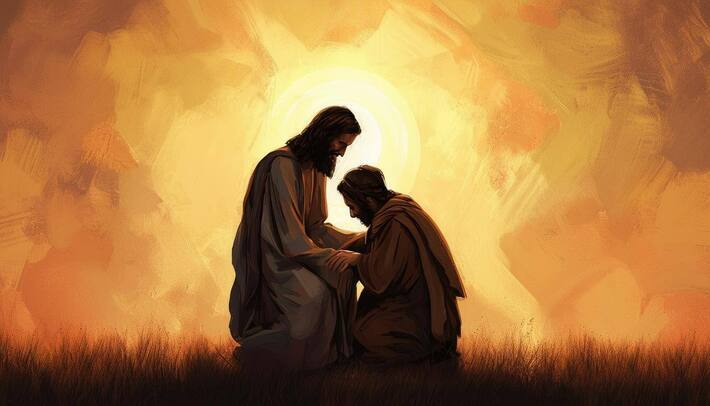
Jesus is doing more than clearing out clutter. He is placing himself at the very center, as the living temple where God and people truly meet.
That means faith becomes more than keeping a set of religious routines; it becomes a real relationship with him. The cleansing is the beginning of a much bigger shift.
Think for a moment about what the temple meant in Israel’s life.
It was the place where people learned God’s ways, confessed sin, offered praise, brought their prayers, and received blessing and assurance. In many ways, the whole spiritual life of the people ran through that building.
And yet, even in the Old Testament, God was already pointing to something more: a day when he would write his law on hearts, pour out his Spirit, and gather worshipers from every nation.
John’s Gospel shows Jesus stepping into that hope and bringing it to life.
In John 1, the Word comes to dwell among us. In John 2, Jesus speaks of his own body as the true temple. In John 3, he tells Nicodemus that what we need is not simply better instruction, but new birth. And in John 4, he tells the Samaritan woman that the old question of where worship happens is giving way to worship in spirit and in truth.
Jesus does not come merely to get the temple “back on track.” He comes to fulfill what it was always meant to point to. In him, we receive instruction, forgiveness through his cross, and the blessing and presence of God in his risen life.
As Hebrews helps us see, he is the final priest, the final sacrifice, and the living sanctuary.
That means two things for us.
First, religion is not enough. You can know the liturgy by heart, show up every week, and still feel like God is far away. If the practices don’t point you to Christ, they will eventually feel hollow.
Second, religion is not the enemy when it is rightly ordered. When Scripture, sacraments, songs, and rhythms of worship all point us to Jesus, they become channels of grace rather than barriers.
In other words, the question Jesus asks is not simply, “Are you religious?” but, “Are you coming to me?” When you come to church, are you coming as to your Father’s house, trusting that the Son has opened the way for you through his own sacrifice?
Letting Jesus Clean House in Your Own Heart and Church Life
Inviting Jesus to “cleanse the temple” today means welcoming him to show us where our habits, expectations, or even our hurts have pushed church away from being a family gathered around the Father and turned it into something lesser.
That kind of honesty touches both our own hearts and our life together as a church.
On a personal level, that may mean asking: Why do I go to church? Is it duty? Nostalgia? Fear of what others will think if I stop? Or is there a real desire to meet Christ, to hear from him, to bring him my sins, questions, and hopes?
When Sunday becomes merely a place to “get religious tasks done,” we’re not far from the outer courts of John 2.
On a congregational level, this means taking an honest look at what shapes our life together.
Are we filling the calendar with activity while leaving too little room for confession, lament, and honest prayer? Are we measuring health mostly by numbers, budgets, and programs, instead of asking whether people are actually growing in love for Christ and neighbor?
Are there patterns of power, favoritism, or avoidance that Jesus would want to confront if he walked through our halls today?
Churches tend to collect both clutter and wounded people. Over time, we accumulate things in our closets and patterns in our hearts, and some of those patterns can end up hurting others even when no one intended that.
Part of following Jesus, then, is letting him ask his searching questions: Why are we doing this? Does it help people see me more clearly, or has it quietly become an end in itself?
When we answer those questions with humility, the result is not a stripped-down, joyless spirituality, but a re-centered one.

We rediscover that we come not to impress God but to meet him as children in the Father’s house. We remember that Jesus’ zeal for that house “consumed” him all the way to the cross, where the temple curtain tore from top to bottom and the way into God’s presence was opened.
If you feel weary of religion but still find yourself drawn to Jesus, that may be his Spirit inviting you to let him do his cleansing work, not by tearing everything down, but by bringing the true center back into clear view: himself.
Why This Story Matters for You Today
John 2 is more than a dramatic moment of Jesus overturning tables. It is also a personal invitation for anyone who feels worn down, disappointed, or confused by religion to meet the real Jesus, the one who loves you enough to clear away whatever stands between you and the Father.
It speaks to seasons of deconstruction, disappointment, and quiet drift.
You might find yourself in one of several places:
- You’ve been hurt by church, and you’re not sure you can risk trust again.
- You’ve stayed in church, but your faith feels thin, more like duty than delight.
- You’re exploring Christianity and wondering whether religious failures disqualify it altogether.
Wherever you find yourself, this story invites you not to stop at the failures of the temple, but to follow the one who walks into it.
Let his anger at corruption remind you that God takes injustice and abuse seriously. And let his determination to clear away distractions reassure you that he wants something deeper for you than a background religion that never reaches the heart.
If this article has stirred questions, memories, or even anger, let that be the beginning of the conversation, not the end of it. Watching the full sermon can give you more space to sit with the passage, hear the parts that a page cannot fully hold, and most of all, encounter Jesus through his Word.
If you can, make the time, bring your doubts and your weariness with you, and ask him to meet you there.
You may find that the very story that once made you uneasy about religion is actually opening a door back into the Father’s house, through the Son whose zeal carried him all the way to the cross so that you could come home.
Like this Article? Share it!


Support the Mission
If you found this article helpful, please consider supporting the mission so we can continue writing these articles to help others who are looking for answers. Thank you!