
Scripture in Our Own Language is a Gift We Easily Overlook
Having the Bible in our own language means we get to hear God speak in words we actually use, letting Scripture shape both our hearts and our everyday lives. Christians once risked their jobs, their homes, and even their lives so ordinary people, such as farmers, merchants, and children, could know Christ through words they could truly understand.
If you grew up with a shelf full of Bibles, or even just a Bible app on your phone, it can be hard to imagine what it would be like to sit through worship in a language you barely understand. But for centuries, that was the experience of most Christians.
Prayers were spoken, Scripture was read, and the sacraments were celebrated in Latin, while many worshippers quietly said their own prayers and listened for the bells that marked the most sacred moments of the service.
The English Reformation began to change all of that. Article 24 of the Thirty‑Nine Articles says that prayer and the sacraments should be offered in “such a tongue as the people understandeth.”
That may sound like a small point at first, but it was really a deeply important one. It reflected a long and costly struggle to make sure ordinary people could actually hear and understand the good news for themselves.
William Tyndale was at the center of that struggle. He believed that the same Lord who spoke through the prophets and apostles wanted ordinary people, including plowboys and housemaids, to hear his Word in language they could truly understand.
That conviction came with real legal and political danger.
In fact, as early as 1408, more than a century before Tyndale published his New Testament, the Oxford Convocation had already tried to close that door by forbidding new Bible translations without official approval.
Five hundred years later, we benefit from the gift of that door being opened again.
We carry in our pockets what earlier generations might have hidden under floorboards. We even use phrases like “the powers that be” or “the spirit is willing, but the flesh is weak” without always realizing they trace back to Tyndale and to a larger movement to put Scripture into the hands of everyday people.
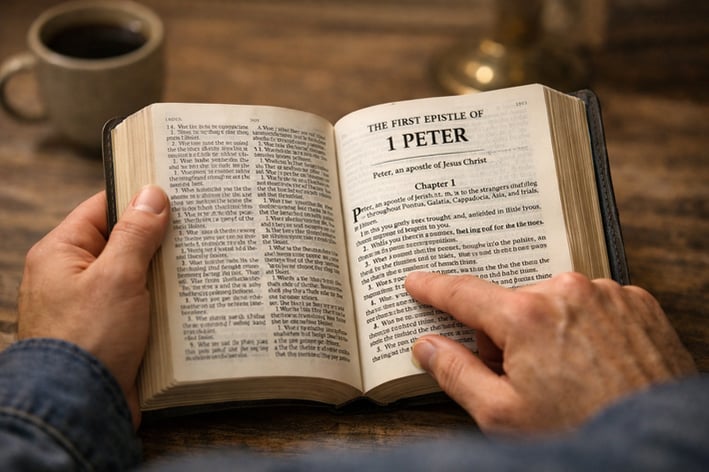
William Tyndale’s Risky Mission to Give Ordinary People God’s Word
William Tyndale’s story reminds us how much it once cost to put the Bible into clear, accessible English, and how strongly he believed that God’s voice should be heard in every home and across every field. His life brings together learning, real danger, and a steady conviction that Scripture is meant for the whole church.
Tyndale was born around 1494 in a trading region where multiple languages flowed through the streets. He developed not only an ear for language but a heart to make language serve the gospel. After studies at Oxford and Cambridge, he was ordained in 1521.
Yet he later complained that his training focused more on commentators than on Scripture itself; by the time students reached the biblical text, they could only hear their teachers’ voices echoing in their heads.
In 1523, Tyndale went to Bishop Cuthbert Tunstall, a respected scholar, and asked for permission to translate the Bible into English.
The bishop said no.
That refusal set Tyndale on a wandering life across the continent, likely taking him through Germany and perhaps even bringing him into contact with Martin Luther. From hiding places scattered across Europe, he kept working steadily on an English New Testament translated not from the Latin Vulgate, but from the original Greek.
By 1526, copies of Tyndale’s English New Testament were quietly making their way into England. They spread so quickly that the Bishop of London tried to gather them up and burn them, turning St Paul’s churchyard into a bonfire of forbidden Scripture.
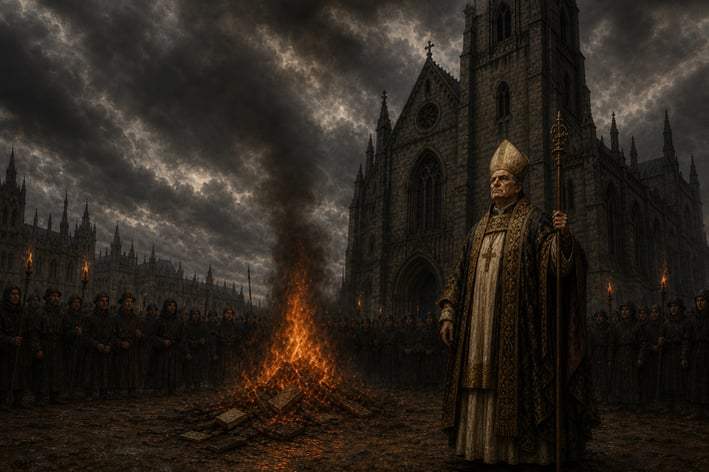
Ironically, when the bishop bought up whole print runs to destroy them, the Printer used that money to produce even more copies, so the effort to stop the translation only helped it travel further.
Tyndale did not stop with the New Testament. In 1530, he also published the first five books of Moses, once again translated from the original languages, and in 1534 he released a revised New Testament.
His dedication came at a heartbreaking cost.
In 1535, he was betrayed by someone he trusted, imprisoned, and then in 1536 strangled and burned. Even so, his words did not disappear. Scholars estimate that about 80% of the King James Version New Testament reflects Tyndale’s phrasing, and one modern historian says his work has had an "immense impact on the English-speaking world" (The Conversation).
Tyndale once told a hostile clergyman, “If God spare my life, ere many years I will cause a boy that driveth the plough shall know more of the Scripture than thou dost.” That bold line gives you a window into his heart.
He believed Scripture was never meant to stay tucked away in universities or cathedrals. It was meant to be heard in fields and kitchens too, by ordinary people who might never study Greek or Latin but who are just as fully invited into the kingdom of God.
The Holy Spirit worked through one scholar, dismissed by some critics as “mediocre,” to help shape the language of prayer, preaching, and even everyday speech for generations to come.
How Tyndale’s Vision Challenges Our Discipleship and Invites Next Steps
Tyndale’s passion for helping people hear Scripture in their own language still speaks to us today. It invites us to build our lives on God’s Word and to help others hear it in a way they can truly understand. His example encourages us both to look back into Scripture and to look ahead with a heart for mission.

Looking back means getting more familiar with the biblical story itself. Tyndale wanted to go further back than the Latin Vulgate, listening again for the voice of St Paul and the vision of the prophets in their original tongues.
For us, that same kind of backward glance can look like rediscovering the Bible we already have; recognizing Ezekiel when he appears in a reading, or hearing “good old St Paul” in the epistles not as a stranger, but as a familiar voice.
That’s one reason we offer Sunday school, Bible studies, and small groups, to help you spend time in Scripture for yourself, not only through the voices of commentators, devotional writers, or even preachers. Tyndale risked his life so that ordinary people could sit at their own tables and read, or hear, the words of Jesus in English.
It would be sad if the most widely published book in history became one of the least read in everyday life.
Looking ahead also means sharing the good news in ways people can truly understand. Even today, there are communities that still do not have the Bible in the language their mother used to comfort them. Translation organizations are carrying Tyndale’s work forward by helping bring Scripture into hundreds of languages, both written and oral.
According to Wycliffe Global Alliance, full Bible translations now exist in just over 700 languages, while more than 3,000 languages still do not yet have the complete Bible, a reminder that this work is not finished. (Wycliffe Global Alliance).
This call to faithfulness is close to home too.
When you explain the gospel to a neighbor, a child, or a co-worker, you are doing a kind of translation work, sharing eternal truth through words, stories, and images they can truly understand. Tyndale’s legacy encourages us to speak of Christ in the everyday language of our workplaces, our kitchen tables, and our friendships.
If you’d like this vision to settle a little more deeply into your heart, here are two simple things you can do this week.
First, open a passage like Matthew 7 and read it slowly, thanking God that you can understand His Word. As you read, ask what it would look like to build your life on the rock by putting Jesus’ words into practice.
Second, take some time to watch the full sermon that inspired this article. Hearing William Tyndale’s story in the setting of worship, prayer, and Scripture can help move it from something you admire to something you begin to live.
When you’re ready, click below to watch the sermon video, and ask God to give you some of the same grace he gave Tyndale, grace to be a faithful witness in words your neighbors can truly understand.
Support the Mission
Help support the church's mission by clicking the Donate button below.