
Recognizing the Holy Pause Between Trial and Response
The holy pause between our suffering and our response is that quiet moment when we choose to trust God instead of reacting in fear or anger. It’s a brief, sacred space between what has happened and how we answer it, where the Holy Spirit invites us to remember Christ and His presence with us, not only our pain.
Many of us recognize this in everyday moments. The last note of an orchestra’s song lingers before people begin to clap. A movie ends and, just before the credits roll, everyone sits together in shared silence. A bride and groom pause for a heartbeat before their first kiss, quietly aware that life is about to change in a beautiful way.
These small moments give us a warm glimpse of a much deeper spiritual reality.
Scripture paints the Christian life as a journey that passes through very real, refining trials on the way to everlasting glory. Peter reminds believers, “Beloved, do not be surprised at the fiery trial that is taking place among you to test you, as though something strange were happening to you” (1 Peter 4:12).
For those scattered and hurting, “strange” probably wasn’t the word they would have picked. Words like “awful,” “terrifying,” or “unbearable” might have felt more accurate.
Yet Peter places a pause between their painful experience and their first, natural reaction. Instead of saying, “Respond the way you always have,” he encourages, “Rather than be surprised, rejoice.”
He is inviting Christians to step into that quiet, holy space, a place one child-development expert once described as maturity: learning to feel at home in the space between what happens to us and how we respond.
This is not about denying what is happening.
It does not ask us to pretend the fire is not hot or the suffering is not real. In fact, reports from around the world remind us how intense Christian suffering can be. One Open Doors study shared that more than 340 million Christians worldwide face serious persecution for their faith, and thousands lose their lives each year because they follow Jesus. (Open Doors).
Peter is not naïve about pain; he is insistent about hope.
What Peter offers is a uniquely Christian way to live in that important in-between space. We do not have to ricochet from our circumstances in anger, despair, or compromise. In Christ, we are invited to pause, look around in that space, and remember: our story is not only about suffering, but about suffering that, in God’s hands, leads to glory.
Learning to Stand in the Space: Humility, Watchfulness, and Letting Go of Anxiety
The space between our suffering and our response is meant to be filled with simple, faithful practices: humbling ourselves under God’s loving hand, handing our worries over to Him, staying awake to spiritual danger, and resisting the enemy with steady trust. In this way, the pause becomes like a workshop where God patiently shapes endurance, hope, and deep joy in us.

In 1 Peter 5:6–11, Peter lays out some very practical “in the meantime” steps for believers.
First, he says, “Humble yourselves therefore under the mighty hand of God, so that he may exalt you in due time.” The promise is not that all suffering suddenly disappears, but that God knows exactly where to find the humble when it is time to lift them up. When He looks across the crowd for those to raise up, He notices the ones who are bowed low in trust, not the ones striving to stay in control.
Second, Peter shows us what to do with the tightness in our chest and the knot in our stomach: “Cast all your anxiety on him, because he cares for you.” The picture is vivid. We gather up the worries that stack up while we wait: concerns about health, family, finances, and faith, and we place them into God’s hands.
This only makes sense if He is close enough to receive them, strong enough not to drop them, and loving enough to carry them for us. Peter says this is exactly who God is.
Third, Peter reminds us that this pause is not a quiet, empty waiting room but a place where real spiritual battle can happen. “Discipline yourselves, keep alert. Like a roaring lion your adversary the devil prowls around, looking for someone to devour. Resist him, steadfast in your faith.”
In hard seasons, we can feel pulled toward quick fixes, making small compromises, giving in to bitterness, or seeking relief in unhealthy ways. Peter encourages us to remember that these “deals” always cost more than they promise and invites us instead to stand firm in trusting Christ.
In moments like this, perspective really helps. Peter reminds us that followers of Jesus all around the world are walking through similar kinds of suffering.

When we remember persecuted Christians in other places, our prayers often soften and shift from, “Why is this happening to me?” to “Lord, please help them,” and then to, “Lord, use this to shape me, too.”
Modern accounts of persecution, including significant increases in violence against believers in some recent years (BBC), remind us that following Christ has always come with a cost, and that we are part of a much larger family of faith.
Even so, Peter does not leave us focused on danger. He closes with a promise about God Himself: “After you have suffered for a little while, the God of all grace… will himself restore, support, strengthen, and establish you.”
Not an angel, not only a pastor’s kind words, but God Himself.
In that quiet pause, four promises open before us like doors: restoration for what has been broken, support when we are about to fall, strength where we are weak, and a firm place to stand when everything around us feels unsteady.
Peter reminds us that our sufferings are deeply connected to Christ’s own suffering because, by faith, we belong to Him. That means the pattern of His story, first suffering, then the resurrection glory, also becomes the pattern of our story.
We are not left to invent our own meaning in the middle of pain. Instead, every fiery trial becomes another place where Jesus’ story is quietly, steadily being written in us.
Baptism, Glory, and a Lifetime of Growing in Grace
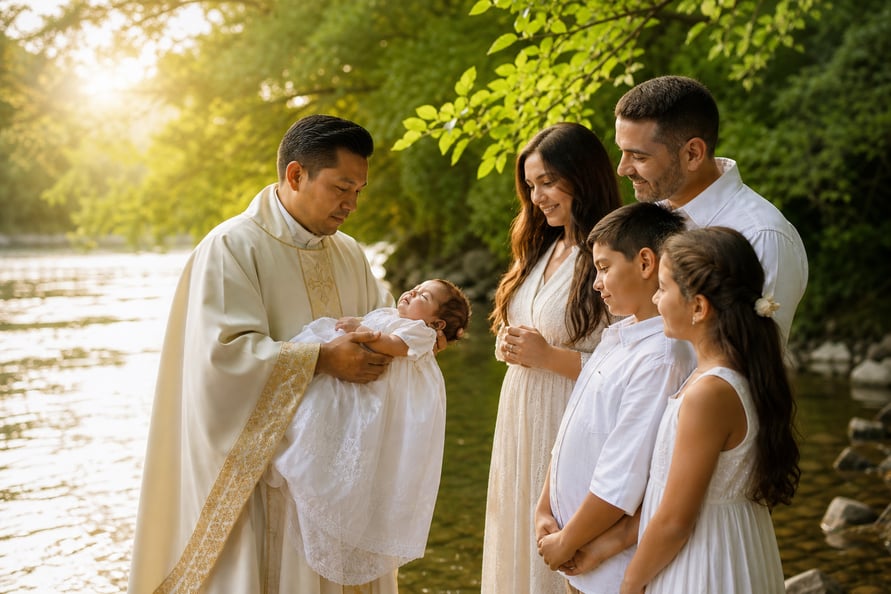
Christian baptism unites us with Christ so that our struggles, our joys, and even our most ordinary days are gathered up into His story of death and resurrection. The moment at the water is brief, but what God begins there unfolds over an entire lifetime, and even beyond.
On the surface, baptism seems very simple: a person comes to the water, a few words are spoken, water is poured, or they are immersed, and then they walk away a bit damp and maybe a little surprised. For an infant, it may last only a few seconds. The child may smile, cry, or simply look around in wide-eyed silence.
Whatever the reaction, something much deeper is taking place: this little one is being lovingly marked with the name of the Father, and of the Son, and of the Holy Spirit.
The Church’s baptismal prayers draw us into a beautiful pattern. They point us to three powerful water-scenes in Scripture and invite us to see our own story in light of them.
First, the Spirit hovering over the waters of creation, a deep, quiet moment before all that is good begins. Second, God opening the Red Sea so Israel can step out of bondage into freedom, pausing on the shore to take in the wonder before walking on dry ground. Third, Jesus entering the Jordan, receiving John’s baptism, and being anointed with the Holy Spirit so that He can lead us, through His death and resurrection, into everlasting life.

In each of these scenes, there is a pause, a quiet stillness before everything that follows. At the baptismal font, we hear a faint echo of that same hush. In baptism, we are joined to Christ: we are buried with Him so that His death takes away the sting of our own, and we rise with Him so that His glory becomes our inheritance.
We are reborn by the Holy Spirit so that God’s work is no longer just around us, but alive and growing within us.
Jesus’ prayer in John 17 takes this even deeper. He talks with His Father about the glory they shared before the world began, the glory He showed on earth by completing His mission, and the even greater glory to which He is returning. Then He says something wonderfully surprising: “I have been glorified in them.”
Imperfect, fickle disciples, one about to betray Him and others about to run away, have somehow brought Jesus glory simply by trusting Him.
This is the heart of what baptism promises and welcomes us into. We bring our real, broken lives, marked by hurt, disappointment, and the weight of a broken world, and we are joined to Christ so that our suffering is no longer empty or pointless.
In God’s caring hands, those hard places become opportunities for restoration, support, fresh strength, and a steady foundation. Our everyday trust, our imperfect obedience, our quiet prayers in the middle of the night, all of these are gently woven into a much larger tapestry of God’s glory.
Revelation offers us one more picture of this holy pause. Around God’s throne, countless beings lift up their song, holding bowls of incense that are the prayers of God’s people. Instruments, whatever they look and sound like in heaven, join in a great, rising chorus.
The music does not drown out the story of the world; instead, it creates a deep stillness in which the Lamb takes the scroll and begins to unfold God’s good purposes for creation.
This is what God is doing in every baptism, in every intense trial, and in every quiet choice to trust Him instead of fear. He keeps inviting us into that sacred in‑between space, between suffering and glory, between water poured and a life fully lived, so that, in the stillness, we can hear His promise: the God of all grace Himself will restore you, support you, strengthen you, and firmly establish you.
And the goodness of that promise will echo through eternity.
Listen to the Full Sermon
Support the Mission
Help support the church's mission by clicking the Donate button below.