
Why Understanding the Gospel Matters More Than You Think
When Jesus tells the Parable of the Sower in Matthew 13, He begins with seed that falls along a hard path and is quickly eaten by birds. In this message, that picture isn’t meant as a final verdict on “hard-hearted people,” but as a kind warning about what can happen when we hear God’s word and simply don’t understand it.
This parable is not a year‑end report card, but an opening check‑in at the start of the school year. The field isn’t cultivated yet. There are still paths, stones, birds, and thorns everywhere.
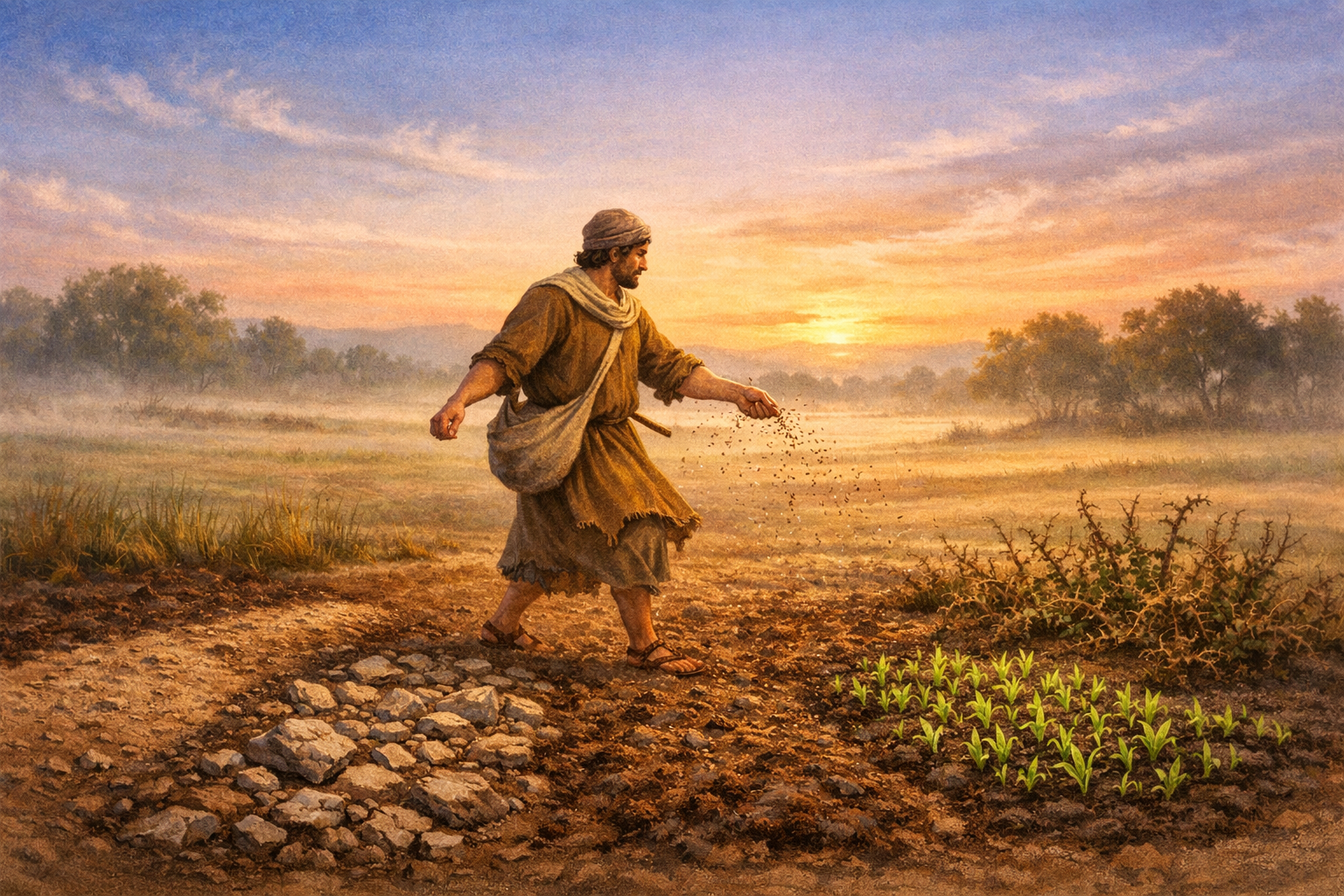
The Sower goes out to create a field where there wasn’t one before, scattering seed into places that aren’t yet productive but could, in time, become wonderfully fruitful.
That shift makes a real difference.
It means Jesus isn’t simply pointing out what’s wrong with “other people.” He’s preparing His disciples for what they’ll encounter as they share the gospel. Some will hear and not understand.
That lack of understanding isn’t automatically a moral failure.
Scripture doesn’t say, “When anyone hears the message about the kingdom and should have understood it but didn’t.” It simply says, “When anyone hears the message about the kingdom and does not understand it.”
What Happens If You Don't Get It
Not understanding something the first time is a deeply human experience. Parents don’t scold newborns for not grasping grammar. They adjust how they speak, their tone, pace, even their silly faces, to communicate love and security long before there’s any real vocabulary.
In the same way, God adapts His communication to us, drawing near in the person of Jesus so that His word comes to us not just as information but as an invitation.
At the same time, this very ordinary feeling of “I don’t get it” can carry real spiritual consequences.
Jesus tells us that when someone hears the word and doesn’t understand it, “the evil one comes and snatches away what was sown in their heart” (Matthew 13:19). Luke puts it even more plainly: the devil takes away the word “so that they may not believe and be saved” (Luke 8:12).
In other words, confusion isn’t something to panic about, but it is something to take seriously, because it can become an open door the enemy would love to use.
Stubbornness, Confusion, or Unable to Understand?

There are familiar examples to help this land. Our congregation recently celebrated the arrival of three baby boys in a row, a living reminder that we naturally adjust how we communicate with those we love.
No one expects a baby to follow a theological lecture, yet many of us quietly assume that if someone doesn’t immediately grasp the gospel, the problem must be their stubbornness.
Jesus’ parable challenges that assumption.
And this isn’t just a Missions concern “somewhere else.” The American Bible Society’s 2024 State of the Church report highlights a large “movable middle” here in the United States: millions who call themselves Christian, many of whom attend church, but remain only lightly connected to Scripture.
They’re not hostile; they’re simply unsure how the Bible connects to everyday life. That’s the hard path in our own pews, and often in our own hearts.
The sermon, linked at the end of this article, explores this tension in greater depth, especially how moments of misunderstanding can open the door to spiritual attack, and how Jesus meets us there. If you’ve ever felt like your faith is thin, confusing, or disconnected from your everyday struggles, spending time with the full message can help you name what’s really going on and see how Jesus is already meeting you there.
Three Common Ways We Miss What God Is Saying
Jesus’ description of the hard path paints a simple picture: the Sower scatters seed, the hearer doesn’t understand, and then the birds swoop in. The seed never has a chance to take root. This pattern raises an honest yet hopeful question: where exactly does understanding break down for the people we care about and for us?
One place is in how clearly we speak about the gospel itself.
It’s easy to talk a lot about church, values, and “being a good person” without ever really naming what God has actually done in Christ. We are reminded that the heart of the good news is Jesus Himself, His perfect life we could not live, His sacrificial death we could never bear, and His resurrection life we could never imagine on our own.
When we don’t say that plainly, it makes sense that people struggle to understand what Christianity is really about.
A second place is our tendency to mumble about the very things Jesus emphasized: sin and mercy, justice and faithfulness, God’s heart for the lost, the least, and the left out. When the church lowers its voice on these themes, maybe to avoid conflict, or to blend in more easily with the surrounding culture, it’s understandable that people might say, “I hear a lot of talking, but I don’t really know what they believe.”
When truth is mumbled instead of spoken clearly and graciously, it becomes easy for it to be snatched away before it can take root.
A third barrier appears when the church speaks with too strong an accent, not the natural accent of a region, but the extra layers of culture, politics, and personal preference that get stuck to the gospel. When we give the impression that following Jesus means coming from a certain part of the country, voting a particular way, or fitting into a specific social mold, they may stumble not over Christ’s strangeness but over ours.
They hear an unfamiliar accent and assume the message is not meant for them.
Fr. Christopher shares a vivid story from our own neighborhood to show how this process can unfold. Two weeks before preaching, he bought a big bag of birdseed from a local Wild Bird Center, hoping to line the church sidewalks with birds as a living illustration.
For ten days, he faithfully scattered seed, but he never once saw a single bird. Even so, the sidewalks weren’t covered with leftovers. Somehow, when he wasn’t around, someone, or something, was quietly coming to eat.
That’s a picture of what’s happening beneath the surface spiritually.

The enemy usually doesn’t snatch away God’s word while we’re actively listening in worship. It’s in the in‑between moments, on the drive home, in the busyness of the week, in the unresolved questions about grief or work or relationships, that confusion lingers, and the birds quietly do their work.
We might still attend church and gladly call ourselves Christians, yet the seed can be eaten up before it has a chance to take root and grow.
Research supports this.
The American Bible Society notes that about a third of Americans are “Scripture disengaged,” another third are actively engaged, and the rest are in that movable middle. Many in that middle say they already know a “Bible person” they admire and even hope to become more like, but they simply don’t know where to begin.
They’re open, but unsettled. This reality becomes a pastoral invitation: what if we saw these neighbors not as “hard ground,” but as people whom God is already inviting us to walk alongside?
Watching the full sermon will give you concrete language, stories, and scriptural anchors to help you recognize these patterns in your own life and community, and to respond with patience rather than blame.
From Hungry Birds to a Fruitful Life: Next Steps
The hopeful promise in this parable is that Jesus doesn’t leave us stuck on the hard path. All through the Gospels, He patiently explains His stories to the disciples, even when they nod along without really grasping what He means.
He quotes Isaiah about people “ever hearing but never understanding,” yet tells His followers they are blessed to see and hear what prophets longed for. His goal is not to shame our confusion, but to heal it.
The New Testament gives us tangible pictures of this healing work.
St. Paul writes the Letter to the Romans as a long, careful explanation of the gospel for people far removed from Jesus’ original time and place. In Acts 8, Philip runs alongside the chariot of the Ethiopian official and asks, “Do you understand what you are reading?” The man answers honestly, “How can I, unless someone explains it to me?”
Philip doesn’t label him as “hard‑path soil.” Instead, he climbs in beside him, starts with Isaiah, and points him to Jesus.

Imagine what it could mean for us to become that kind of community, a place devoted to “skinny bird ministry,” where the enemy goes hungry because God’s word is welcomed, understood, and given room to grow.
That means we don’t settle for ricocheting seeds. Instead of thinking, “If they don’t get it, it’s their fault,” we take responsibility to speak clearly, to remove unnecessary cultural barriers, and to walk alongside people as they wrestle honestly with Scripture.
This is true not only in “outreach” but in our own questions. Many of us quietly carry areas where we think, “I don’t see how the gospel connects to this part of my life:” my grief, my anger, my work, my marriage, my doubts.
When we leave those places untouched, they can become easy targets for the enemy.
There is hope: as we bring those questions into the light of Jesus’ life, death, and resurrection, understanding begins to grow. And as understanding deepens, our lives become increasingly fruitful.
Coming soon, New Covenant will host a special teaching time with Zach Baldwin, who has been serving as a chaplain with InterVarsity at Rollins College. Zach will help us think about how to share the gospel with people who have heard it before and then stepped away.
Many of us have family members, friends, or co‑workers in that place. The seed was planted, but it seemed not to sink in. This upcoming conversation will offer down-to-earth, hopeful ways to re‑engage those we love with patience, clarity, and confidence in God’s ongoing work in their lives.
If any of this resonates with you, if you sense “birds” circling around the seeds in your own life, or if you’d love to help others understand the good news more deeply, we invite you to watch the full sermon video below. You’ll come away with very practical next steps for prayer, engaging with Scripture, and having thoughtful conversations with others.
Set aside some unhurried time this week to listen, reflect, and ask the Lord to move you from confusion to understanding, and from a hard path to a life that bears a hundred‑, sixty‑, or thirty‑fold harvest.
Support the Mission
Help support the church's mission by clicking the Donate button below.