
The Promised Holy Spirit and God’s Promise Not to Leave Us
The promised Holy Spirit is God’s way of keeping His promise never to leave His people alone. Jesus assured His disciples that the Father would send the Spirit so that God’s presence would no longer feel “back then and over there,” but “here and now, right with you and living in you.”
In the book of Numbers, we see God leading Israel through the wilderness, like a steady guide, with a pillar of cloud by day and a pillar of fire by night. Whenever the ark of the covenant set out, Moses would pray, “Rise up, Lord!” and when it came to rest, he would pray, “Return, Lord.”
That simple rhythm shows how deeply they relied on God being close. Their sense of safety wasn’t in having easy circumstances, but in trusting a faithful God who walked with them every step of the way.
There is a clear line from that wilderness journey to the coming of the Spirit at Pentecost.
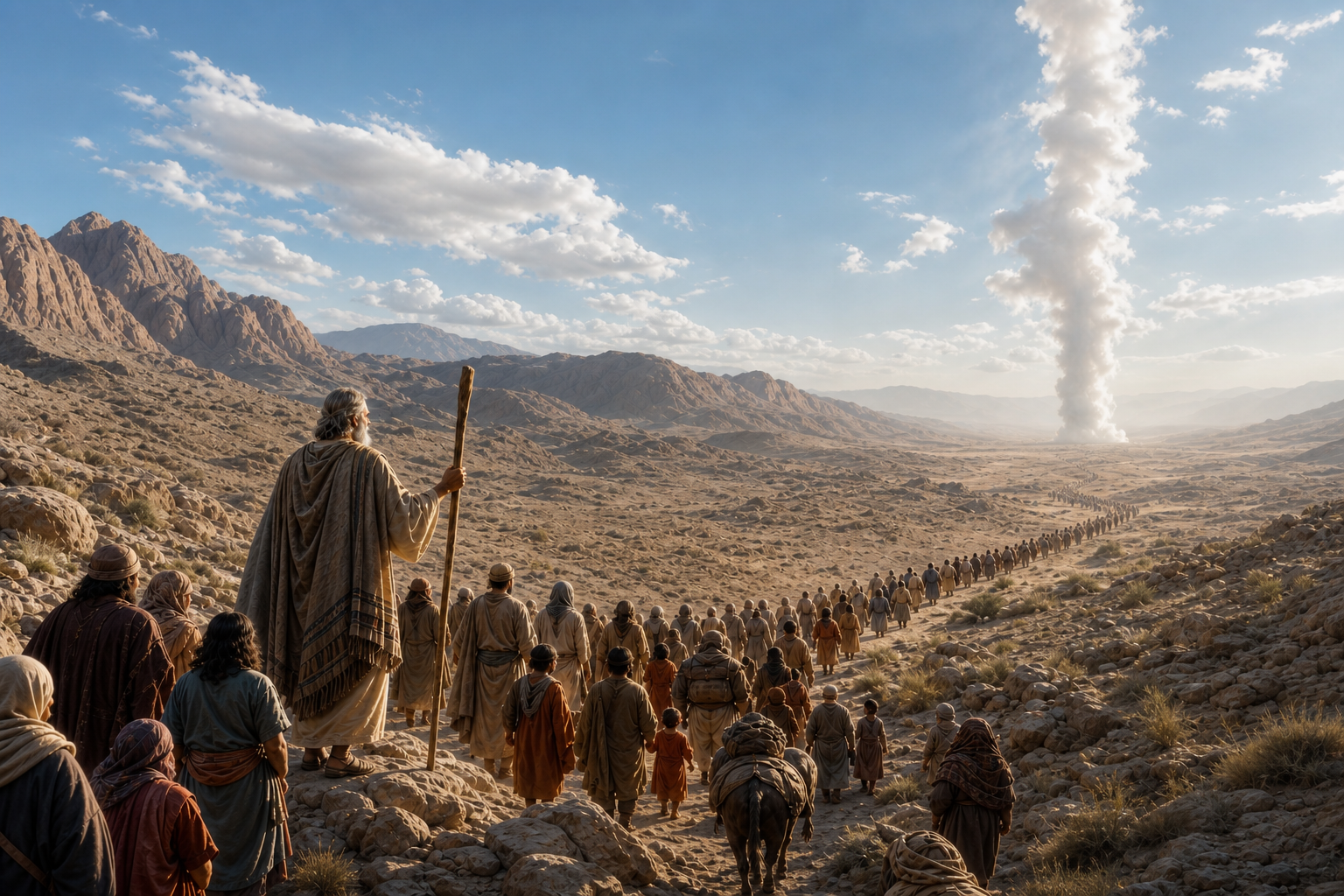
The same God who would not leave Israel alone in the desert will not leave His Church alone today. Just as the cloud once rose to protect and lead Israel, the Holy Spirit now goes ahead of us into each day, into our workplaces, our homes, and even into the quiet places where we carry our worries and fears.
Picture a child being asked to get off a train a couple of stops too early and “figure it out alone.” God makes it clear that this is not how He treats His people.
Because of the Spirit, God does not send us part of the way and then step back. Instead, He stays with us and carries us all the way, assuring us of His presence right up to “the end of the age.”
When We Forget God’s Presence and Rewrite Our Own Story
When we lose sight of the Holy Spirit’s nearness, we don’t just find ourselves grumbling about what is happening; we slowly begin to retell our whole story. Israel did this in Numbers 11, calling the food in Egypt “free” and speaking as if life in slavery had been comfortable and generous, instead of a harsh life without freedom or dignity.
When we start to assume God is absent, we also start to retell our past as if God was never with us at all.
For Israel, the manna they were eating, truly free food, given fresh by God every morning, began to feel like something they were tired of seeing. What had been a generous gift began to feel ordinary; a daily miracle felt like mere routine.
We do something similar when we say in our hearts, “God, You’re not here right now, and I’m not sure You were ever really with me.”

In those moments, we look back on a crisis, a loss, or a disappointment and quietly overlook the ways God’s mercy met us there; the friend who showed up, the prayer that gave us strength, the unexpected peace that did not seem to make sense at the time.
Notice how the spirit of complaint grows in this passage.
It begins with a few people grumbling, and soon “every family” is standing at the tent door, adding their own words to the chorus. What started as a real hardship slowly becomes a shared story of feeling abandoned.
In today’s language, the “family story” can begin to sound like this: “Nothing ever works out for us. God never really helps us.”
The story in Numbers reminds us of something important: when we stop looking for the Spirit’s work, we can slowly begin to leave God out of how we remember our past and how we imagine our future.
How the Spirit Transforms Our Words, Families, and Church
One of the clearest signs of the Spirit’s work is that He changes the way we talk. In Numbers 11, God asks Moses to gather seventy elders. God then takes some of the Spirit on Moses and shares it with them, and when the Spirit rests on them, they begin to speak God’s words.
This is not about suddenly being able to predict far‑off events. It is about our everyday speech being shaped by God, words that encourage instead of words that wound. These are the very same leaders whose homes had once been filled with complaint.
Under the Spirit’s power, their words shift from grumbling to grateful testimony.
Families today often have their own “complaint songs,” much like Israel did; the vacation that went sideways, the job that fell through, the season that seemed marked by disappointment.

Without the Spirit’s help, those stories can become the main soundtrack of a home. With the Spirit, those very same memories can be told again with mercy, gratitude, and hope.
Even more encouraging is the example of Eldad and Medad.
They never make it to the gathering at the tent; they stay back in the camp. Yet the Spirit rests on them too, and they begin to speak God’s words right where they are. God is not “short” on the Holy Spirit; He isn’t limited to a sanctuary, a microphone, or a title.
God is not carefully rationing His Spirit.
God plans to put His words on the lips of everyday believers, parents around a dinner table, friends in a hospital waiting room, coworkers on a break, so that our ordinary conversations can become a gentle way His presence is shared.
From Numbers to Pentecost: A Promise Fulfilled for All People
Pentecost is the joyful moment when the promised Holy Spirit is not limited to one leader, one group, or one nation. What God began with Moses and the elders in Numbers is fulfilled in Acts 2, as tongues of fire rest on 120 believers and each one begins to speak, just as the Spirit gives them the words.
Moses once cried out, “I wish that all the Lord’s people were prophets and that the Lord would put His Spirit on them all!” At Pentecost, that longing finally comes true. The Holy Spirit is poured out “on all flesh,” on sons and daughters, young and old, women and men, and even on those the world tends to overlook or hold in bondage.

Notice how practical this is: the Spirit does not only stir our feelings; He also gives us words to say. People from every nation under heaven hear “the wonderful works of God” in their own everyday languages.
The very tongues God’s people had once struggled to learn in exile now become the familiar channels for fresh good news.
Historical studies of the early Church point out how quickly the good news of Jesus spread across cultures and borders. A big reason for this is simple: everyday believers talked about Christ in the ordinary languages of the marketplace and the home.
Pentecost was not just a one‑day spiritual fireworks display; it was God kindly equipping the Church to speak His hope into real, everyday life.
Some in the crowd respond with a sneer, saying, “They’ve had too much new wine.” That same kind of mocking still shows up whenever believers speak as if God is actively at work today, not just in the distant past.
But Peter answers by turning to Scripture, explaining that what they are seeing is exactly what God promised long ago through the prophet Joel.
Living as if the Holy Spirit is Really Among Us Today
If Pentecost is real, then the Holy Spirit today is not just an idea we believe but a living presence with us. The hard part is learning to live as if that is true when the world feels like “blood and fire and smoky mist,” when the news makes it seem as though everything is coming apart.
Acts 2:21 reassures us, “Everyone who calls on the name of the Lord shall be saved.”
This promise becomes like a steady anchor when life feels unsettled. The Holy Spirit does not remove every hardship, but He guarantees that no one who turns to Christ is ever left alone. Salvation is not only about what happens after we die; it is also about God meeting us, helping us, and holding us in the middle of our lives right now.
In everyday terms, this means welcoming the Holy Spirit into the very places where our grumbling tends to grow.
For instance, a family might set aside just five minutes on a Sunday evening to replay the week, not only naming what was hard, but also noticing where God was quietly faithful. A small group in a parish might simply ask, “Where have we seen the Spirit at work among us this month?” and listen to one another with care.

Church history is full of stories that encourage us in this way. In seasons of war, sickness, and social turmoil, followers of Jesus who leaned intentionally on the Holy Spirit often became quiet centers of peace, loving service, and brave witness.
Their circumstances were not necessarily easier, but their confidence grew deeper in a God who truly keeps His promises.
To live Pentecost in our daily lives is a bit like praying with Israel in the wilderness: “Rise up, Lord” as the day begins and “Return, Lord” as it comes to a close, resting in the trust that, all day long in between, the cloud of God’s presence has gone ahead of us and stayed with us.
Why the Sermon Matters
Fr. Christopher Caudle’s sermon is more than a Bible lesson on Numbers 11 and Acts 2; it’s an invitation to step into the story of the promised Holy Spirit and to recognize your own life inside God’s promises kept.
As you listen, you’ll notice how he weaves together vivid pictures, a child on a train, families singing their own “blues,” Eldad and Medad prophesying from the back of the camp, into one invitation: trust that God has not left you and will not leave you.
The very same Spirit who rested on Moses, the elders, and the first disciples is available to you today.
If you have ever wondered whether God is still active right now, whether He still speaks, or whether Pentecost is anything more than a date on the church calendar, this sermon is for you. It pushes back on the quiet thought that God only worked in the past and invites you to look for His living presence with fresh hope today.
As you watch, invite the Holy Spirit to speak to your heart. Then consider one practical response, maybe trying a new way of praying at the beginning and end of your day, or choosing to let the Spirit reshape how your family tells its story.
Let this message encourage you to live as someone who is learning, day by day, that God really does keep His promises.
Support the Mission
Help support the church's mission by clicking the Donate button below.