
Why the Rocky Soil Matters for Your Life with Jesus
In the parable of the Sower, the rocky soil points to people who welcome God’s word with joy yet find their faith shrinking back when following Jesus starts to cost them something. It isn’t about “fake Christians,” but about the very real ways disciples stay shallow instead of letting their roots go deep.
In Matthew 13, Jesus tells us that the seed on rocky ground stands for those who “hear the word and at once receive it with joy,” but then struggle to keep going when trouble or opposition comes because of the word. In other words, the same Jesus who comforts us also invites us into costly obedience.
Recognizing the Spiritual Workarounds That Hold Us Back
Many of us aren’t blocked by just a few scattered rocks, but by a hidden layer of stone beneath what looks like good soil. On the surface, everything appears healthy: we come to worship, we’re encouraged by Scripture, and at first our faith seems to grow quickly.
But when our roots try to go deeper, they bump into something hard.
These hidden layers are the “workarounds” we build into our discipleship. A workaround is when we quietly say, “Jesus, you can have this part of my life, but not that part. Please just go around it for now.”
That “off‑limits” place might be a relationship, a habit, a wound, or even a long‑standing parish practice that feels too painful or too complex to touch.
Farmers in rocky parts of Palestine often worked with a thin layer of soil over a shelf of limestone. Seeds would spring up quickly because the ground warmed fast, but when the sun grew hot, plants with shallow roots withered.
In a similar way, our spiritual workarounds can let us look leafy and vibrant for a season, even as we hold back the very places Jesus longs to reach and heal.
When Blessings Feel Threatening: Trouble ‘Because of the Word’

Jesus is very clear with us: the real test for rocky‑soil disciples comes when “trouble or persecution” shows up because of the word. It’s not just random hardship; it’s the pushback that comes when we actually begin to live out what Jesus says.
In everyday life, that might look like a relationship feeling strained when you refuse to join in gossip, a financial sacrifice when you give generously instead of clinging to security, or tension at work when you choose integrity over cutting corners.
In those moments, many of us feel surprised, even a bit confused: “I thought Jesus came to make my life better. Why does obedience sometimes make things feel harder?”
Some teachers have noticed that this feeling of disappointment is very much what Jesus is warning us about in the parable. One article on spiritual growth and the Sower notes that rocky‑soil hearts often begin with great enthusiasm but stumble when obedience bumps up against our desire for comfort.
The issue is not that God stops blessing us; it’s that shallow roots make it hard for us to draw on his grace when life gets hot.
We are invited to notice when we start seeing God’s good gifts, sun and rain, joy in worship, encouragement from Scripture, as unwelcome because they press on our hidden rocks. When that happens, even blessings can start to feel a bit scary, and that’s exactly where Jesus wants to meet us with patience and love.
Letting Jesus Touch the Places You Don’t Trust Him Yet
So, what do we do with these deeper layers? The answer is not to berate ourselves or pretend we don’t have limits. Instead, the first faithful step is simple honesty.
It is far better to say to the Lord, “Jesus, I don’t trust you with this part of my life yet,” than to cover that reality with spiritual‑sounding words.
We are encouraged to bring before God at least one area we’ve fenced off—a memory, a fear about the future, a pattern of sin, or a long‑standing family habit. Simply naming it doesn’t make the rock disappear, but it does open the door for a real, honest conversation with Jesus.
Later in scripture, Jesus speaks of faith as small as a mustard seed that can move mountains. You are not asked to show up with spiritual dynamite to blast away your own rocky shelf.
Instead, the invitation is to come to him, even in weakness, and pray, “Plant that mustard‑seed faith in me. Begin to break this rock in your time and your way.”
Over time, Jesus is able to turn hard places into soft, rich soil where roots can finally grow deep.
From Rocks to Rich Soil: Personal and Parish Transformation
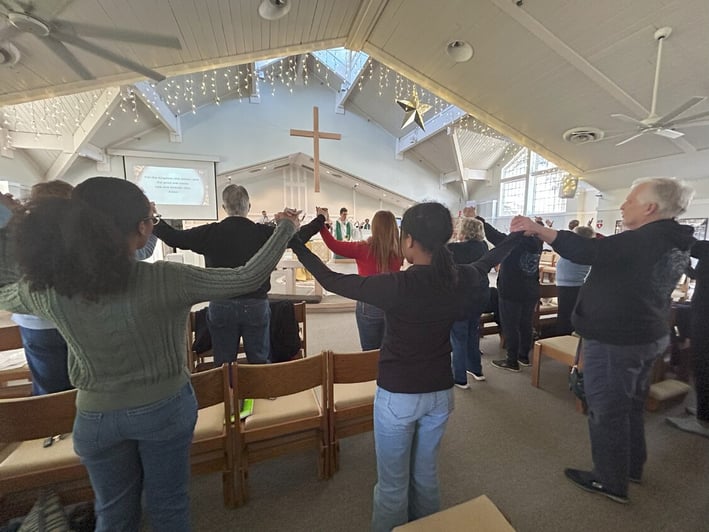
This parable is not only speaking to individual hearts; it also offers gentle wisdom for whole communities. Churches, like people, can learn to work around certain issues for a long time. We say things like, “We just don’t talk about that,” “We’ve always done it this way,” or “Let’s not disturb that arrangement.”
Over time, those patterns can act like a layer of rock beneath what otherwise looks like a healthy parish.
We are invited by New Covenant Church to notice both our personal and our shared “rocks.” What practices, unspoken agreements, or long‑held hurts have we simply learned to work around? And what might Jesus be asking us, this Lent, to let him gently touch, for the sake of a more fruitful future, bearing thirty, sixty, or even a hundredfold?
Scripture, along with reflections from other teachers on Matthew 13, points us to a hopeful truth: soil can change. Through confession, repentance, mutual encouragement, and patient obedience, God can take communities that seem leafy but shallow and grow them into fields that bear lasting, beautiful fruit here in Winter Springs and beyond.
Watch the Sermon and Take Your Next Concrete Step
An article can only go so far. The full message on the rocky soil walks slowly through Matthew 13, offers vivid stories, and gives space to listen for what the Holy Spirit is surfacing in you.
As you watch:
- Ask the Lord to show you one "workaround" he is inviting you to surrender this Lent.
- Write it down, name it to Jesus, and ask for mustard‑seed faith to trust him there.
- Consider sharing with a trusted friend or small‑group member so you can pray together.
The Sower in Jesus’ parable sees more than the birds, rocks, and thorns; he sees the harvest that’s possible. In the same way, the Lord is gently sowing his word into your life and into our parish, not to shame us, but to deepen and steady our joy beyond what we’ve imagined.
Take some time to watch the sermon below and let your roots grow a little deeper this season.
Support the Mission
Help support the church's mission by clicking the Donate button below.